
How extreme heat affects tire pressure in Dominican Republic

Introduction
Living in the Dominican Republic means navigating a tropical climate characterized by high temperatures and intense solar radiation. For vehicle owners, these environmental conditions directly impact mechanical components, with tires being among the most vulnerable. Understanding how extreme heat alters tire pressure is essential for ensuring vehicle stability, fuel efficiency, and long-term safety on local roads.
Tire pressure is not a static measurement; it fluctuates constantly based on the ambient temperature and the heat generated during driving. When the air inside a tire heats up, the molecules move faster and push harder against the inner walls, increasing the internal pressure. Ignoring these changes can lead to unpredictable handling or even sudden tire failure, especially during the hottest months of the year.
Monitoring this relationship is a vital part of routine vehicle maintenance. By learning how to manage pressure fluctuations caused by the Caribbean sun, drivers can prevent premature tire wear and avoid the risks associated with improper inflation levels.
The science of thermal expansion in tires

To understand why heat is such a significant factor, one must consider the principles of thermal expansion. Inside every tire, there is a specific volume of compressed air. As the temperature rises, whether due to the midday sun in Santo Domingo or the friction generated by driving on asphalt, the air molecules gain kinetic energy. This increased energy causes them to collide more frequently and forcefully against the tire's interior.
This process results in an increase in PSI (pounds per square inch). A general rule of thumb is that for every significant rise in temperature, there is a corresponding rise in pressure. Conversely, when the temperature drops during cooler nights or during a tropical rainstorm, the pressure will decrease. This constant "breathing" effect means that a tire that appears perfectly inflated in the cool early morning might actually be over-inflated by noon.
Risks of improper pressure due to heat
Failure to account for heat-induced pressure changes can lead to several dangerous scenarios. When tires are significantly over-inflated due to extreme heat, the contact patch—the amount of rubber actually touching the road—becomes smaller. This reduces traction, making the vehicle more prone to skidding during sudden maneuvers or when encountering wet surfaces during a heavy downpour.
On the other hand, if a driver ignores a low-pressure warning because they assume the heat will fix it, they risk under-inflation. Under-inflated tires generate much more internal friction, which creates even more heat. This can lead to a "runaway" heating cycle, where the tire structure begins to degrade, potentially resulting in a blowout. Furthermore, improper inflation levels significantly increase fuel consumption, as the engine must work harder to overcome the irregular rolling resistance.
Practical steps for maintaining correct pressure
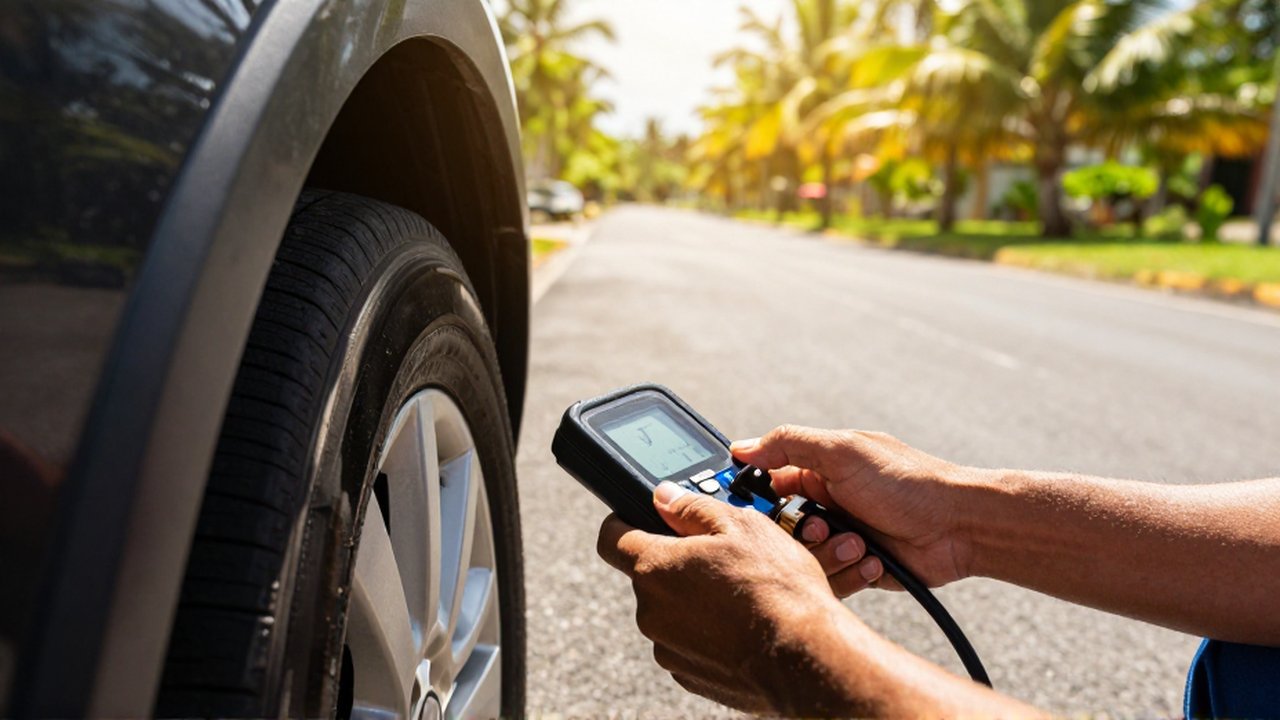
Managing tire pressure in a tropical environment requires a proactive approach rather than a reactive one. Following these guidelines can help maintain vehicle safety:
- Check pressure when tires are cold: The most accurate reading is obtained when the car has been parked for at least three hours or driven less than a mile. This ensures the reading reflects the ambient temperature rather than heat generated by driving.
- Follow the manufacturer's specifications: Always refer to the sticker located on the driver's side door jamb or the vehicle owner's manual. Avoid using the "maximum pressure" listed on the tire sidewall, as this is a limit, not a recommended daily operating pressure.
- Use a reliable pressure gauge: Do not rely on visual inspections. A tire can look "flat" or "full" while actually being well outside the safe operating range.
- Perform monthly inspections: Given the consistent heat in the Dominican Republic, monthly checks are recommended to catch slow leaks or significant fluctuations early.
Comparison of pressure states
| Condition | Internal Pressure Trend | Primary Risk | Handling Impact |
|---|---|---|---|
| Extreme Heat/High Speed | Increases | Over-inflation / Blowout | Reduced traction and center stability |
| Cooler Morning/Rain | Decreases | Under-inflation | Increased rolling resistance and heat buildup |
| Ideal/Standard | Stable | Minimal | Optimal grip and fuel economy |
Frequently asked questions
Does driving on hot asphalt change my tire pressure? Yes. The intense heat from the road surface transfers to the tires, significantly increasing the internal air pressure and the temperature of the rubber.
Can I check my tire pressure at a gas station during the day? You can, but the reading may be higher than the actual "cold" pressure. It is always best to calibrate your pressure based on the manufacturer's recommendation for cold tires.
Why does my TPMS light turn on after a long drive in the sun? The Tire Pressure Monitoring System (TPMS) detects fluctuations. If the light turns on after driving in the heat, it may be detecting a pressure spike or, more commonly, noticing that the pressure has dropped significantly relative to the new temperature.
How often should I inspect my tires in the Dominican Republic? Due to the high temperatures and varying road conditions, a monthly inspection of tire pressure is highly recommended to ensure safety and efficiency.
Leave a Reply