
How tropical dust affects vehicle air filter life

Introduction
The engine of a vehicle requires a precise mixture of fuel and clean air to function efficiently. The air filter serves as the primary defense mechanism, capturing microscopic particles before they enter the combustion chamber. In tropical environments, such as the Dominican Republic, the presence of airborne dust, fine sand, and organic debris significantly alters the operational conditions of this component. Understanding how these environmental factors impact filtration is essential for maintaining engine health and performance.
Maintaining a clean air filter is not merely a matter of routine maintenance; it is a necessity for preventing premature engine wear. Tropical dust is often finer and more pervasive than dust found in temperate climates, meaning it can clog the filtration media much faster than the manufacturer's standard estimates suggest. When the filter becomes saturated, the engine struggles to "breathe," leading to a cascade of mechanical and economic consequences.
Impact of fine particulate matter on engine performance

Tropical regions often experience high levels of airborne particulates caused by dry seasons, unpaved roads, and coastal winds. These particles, ranging from large grains of sand to microscopic silt, rapidly accumulate on the surface of the air filter. As the layer of dust thickens, the pores within the filter material become obstructed. This restriction creates a significant pressure drop between the outside atmosphere and the intake manifold.
When the air intake is restricted, the engine's Electronic Control Unit (ECU) must compensate to maintain the correct air-fuel ratio. In many modern vehicles, this results in the system injecting more fuel to make up for the lack of oxygen. This adjustment leads to several immediate issues:
- Reduced Fuel Efficiency: The engine consumes more gasoline to perform the same amount of work.
- Decreased Power Output: The lack of sufficient oxygen prevents optimal combustion, making the vehicle feel sluggish, especially during acceleration or when climbing hills.
- Increased Emissions: Incomplete combustion leads to higher levels of exhaust pollutants, which can harm the environment and potentially damage sensitive catalytic converters.
Risks of neglecting air filter replacement
Allowing a heavily soiled air filter to remain in a vehicle poses long-term risks to the mechanical integrity of the engine. While the primary job of the filter is to block debris, all filters have a limit. If a filter becomes completely saturated or if the housing is not properly sealed, fine dust can bypass the media entirely.
Once these microscopic particles enter the combustion chamber, they act as an abrasive. This "sandblasting" effect occurs at incredibly high speeds and temperatures, leading to the degradation of piston rings, cylinder walls, and valve seats. Such wear can cause loss of compression, increased oil consumption, and eventually, catastrophic engine failure. Furthermore, the increased load on the engine caused by restricted airflow can lead to higher operating temperatures, putting additional thermal stress on various internal components.
Maintenance intervals in tropical climates
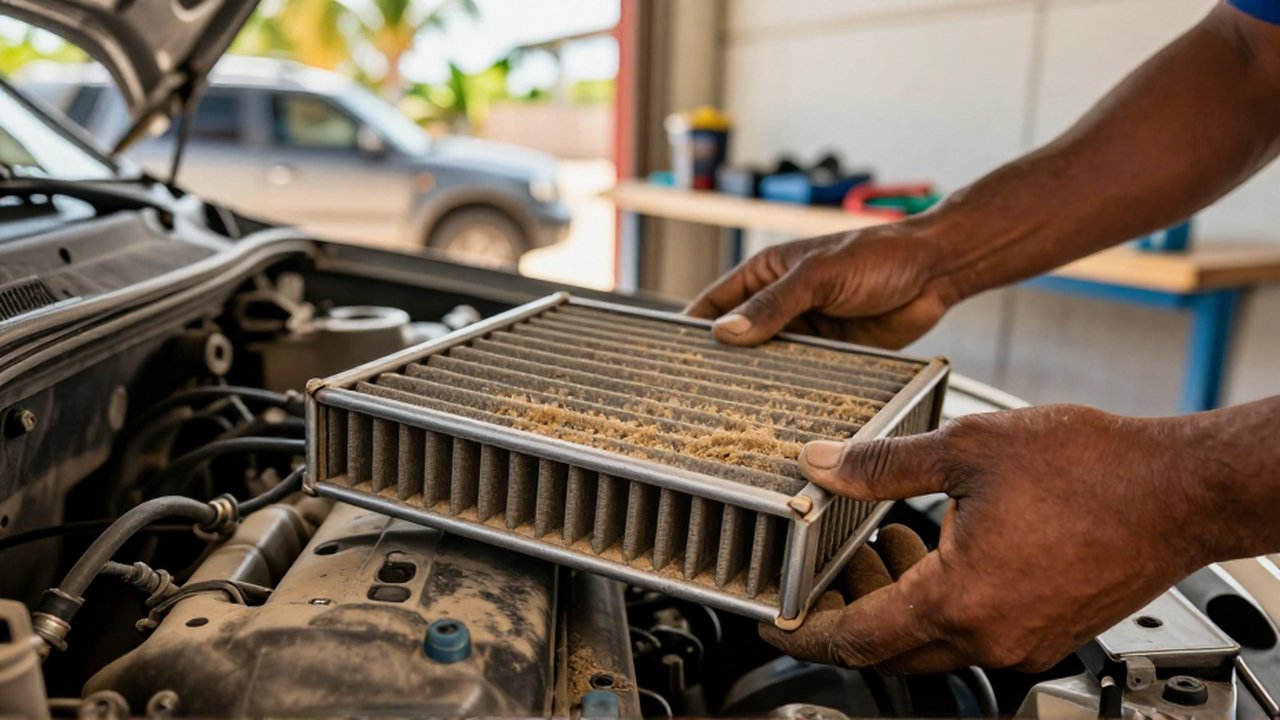
Most vehicle manufacturers provide recommended service intervals based on "ideal" driving conditions. However, driving in a tropical environment with high dust concentrations is considered "severe service." This means the standard mileage intervals for filter replacement may not be sufficient.
To ensure reliability, vehicle owners should move away from a fixed-mileage mindset and transition toward a visual inspection strategy. It is highly recommended to check the air filter every few months or after traveling through particularly dusty or unpaved areas.
| Condition | Suggested Action |
|---|---|
| Light dust accumulation | Gentle cleaning (if permitted by manual) or monitoring. |
| Visible heavy discoloration | Immediate replacement. |
| Obstructed filter pleats | Immediate replacement. |
| Post-heavy dust storm/season | Mandatory inspection of both filter and intake housing. |
It is important to note that many modern paper-based filters are designed to be disposable rather than cleaned. Attempting to blow out a paper filter with compressed air can sometimes create microscopic holes in the media, rendering it ineffective at stopping the fine dust characteristic of tropical regions.
Common mistakes in air filter care
A frequent error among vehicle owners is relying solely on the manufacturer’s manual without considering local environmental variables. Following a schedule designed for temperate, paved highways while driving on dusty, rural roads will inevitably lead to a clogged filter much sooner than expected.
Another mistake is the improper installation of a new filter. If the filter is not seated perfectly within the housing, or if the clamps are not tightened correctly, dust will find the path of least resistance through the gaps. This bypasses the filter entirely, sending unfiltered air directly into the engine. Finally, many owners mistake a dirty engine air filter for a different issue, such as a faulty fuel pump or spark plugs, when the root cause is simply a lack of oxygen caused by a clogged filter.
Frequently Asked Questions
Can I clean my air filter instead of replacing it? It depends on the material. Reusable cotton gauze filters can be cleaned with specific kits, but most standard paper filters are designed for single use. Attempting to clean a paper filter can damage the fibers, allowing dust to enter the engine.
How can I tell if my air filter is clogged? Common signs include a noticeable drop in fuel economy, hesitation during acceleration, increased engine noise, or the "Check Engine" light appearing on the dashboard.
Does humidity affect the air filter? Yes. In tropical climates, high humidity can cause dust particles to clump together on the filter, making them heavier and more difficult to dislodge. In extreme cases, moisture can cause the filter media to lose its structural integrity.
Should I clean the air box if I change the filter? Yes. When replacing a dirty filter, it is essential to wipe out the air filter housing to remove any loose dust that has settled at the bottom. If left there, this dust can be sucked into the engine when the new filter is installed.
Leave a Reply